
WHAT IS JOVIOS
What JoviOS is, and the blind side it covers
What is revenue intelligence?
Revenue intelligence is software that tells you what is happening to your revenue. Most of it reads one side: your own data, meaning pipeline, sales conversations, and CRM activity. That explains the quarter you are already in.
JoviOS reads both sides. We monitor your systems and read the plan and the beliefs underneath it. We also read the external conditions the plan depends on: who your buyers actually are, what they want, what competitors are doing, what budgets allow.
Every revenue plan rests on beliefs about those conditions. An ICP definition is a belief. So is the reason buyers choose you, and the budget climate you priced against. Those beliefs were true when the plan was written. Conditions move, and the beliefs quietly stop matching.
That gap is drift. Because JoviOS monitors both sides in real time, it registers drift the moment it starts rather than after it accumulates. That is what creates the lead time: we quantify the effect on your numbers up to four months before it reaches your dashboard, which is enough time to adjust the plan while adjusting still changes the outcome. Drift runs in both directions, so the same signal that flags a threat also surfaces an opportunity.
What is drift?
An assumption beneath the plan is a fixed bet. Reality moves away from it. The gap that opens between them is the drift. The drift opens before it reaches the number, which is why JoviOS can surface it up to 4 months before reporting would.
How does JoviOS see a problem up to 4 months early?
Because the drift opens at the assumption layer before it ever reaches the reported number. Dashboards and forecasts watch the number, so they can only show a problem after it has moved. JoviOS watches the layer beneath, where reality first pulls away from the assumptions the plan rests on. That gap is visible there up to 4 months before it surfaces in reporting, which is the window where you can still act.
How is JoviOS different from a dashboard?
JoviOS is the opposite of the dashboard. A dashboard reports the number and its KPIs, the outcome, after it has already moved. KPIs cannot warn you, because they rest on the very assumptions reality has moved away from. JoviOS watches that layer beneath the number, where the drift opens first, so the problem is visible before it reaches the report the dashboard would show you.
How is JoviOS different from Clari and Gong?
Clari and Gong are revenue intelligence tools. They read execution signals, sales conversations, pipeline movement, and deal activity, to sharpen the read on the number as it forms. That work sits at the execution layer, on the deals in motion. JoviOS sits a layer beneath, on the assumptions the whole plan rests on, where reality pulls away before any of it shows up in pipeline or calls. The difference is the layer, not the feature. They read what is happening in the deals. JoviOS reads whether the assumptions underneath the plan still hold.
How JoviOS is different from Clari and Gong How is JoviOS different from planning tools?
Planning tools author the plan. Anaplan, Workday Adaptive, and Pigment are where the plan is built and the targets are set. JoviOS governs the plan they produce. It does not author the targets; it checks whether the assumptions beneath them still hold once reality starts to move. The plan is the input. The drift on its assumptions is what JoviOS watches.
How is JoviOS different from monitoring and anomaly tools?
Monitoring and anomaly tools watch the outcome and alert once the number is already moving. By the time the alert fires, the shift is underway and the window to act has narrowed. JoviOS watches what moves first, the drift on the assumptions beneath the plan, not the number that moves last. It surfaces the gap while the number still looks fine, which is earlier than any alert on the number itself can be.
How is JoviOS different from monitoring and consulting?
Consulting diagnoses once. A firm comes in, studies the plan, delivers a read, and leaves, and the read is a snapshot of the assumptions as they stood that quarter. JoviOS is a continuous governance loop. It instruments the assumptions and rechecks them as reality moves, so the drift is caught when it opens, not at the next engagement. The difference is not the quality of the analysis. It is that the watch never stops.
What does JoviOS not do?
JoviOS does not author your plan. Planning tools such as Anaplan, Workday Adaptive, and Pigment do that, and JoviOS governs the plan they produce. It does not monitor the number and alert once it has already moved, which is what dashboards and early-warning tools do, and by then the window has closed. It does not promise immunity from a miss. Like a left tackle, its job is to give you sight of the hit you would not otherwise see, and time to act, not to remove the rush. And it does not only find problems. Drift runs two ways, so JoviOS quantifies the openings where reality has turned in your favor alongside the breaks where it has pulled away.
Your plan counts on a market that has already changed. The Blindside Brief shows you where. Free.
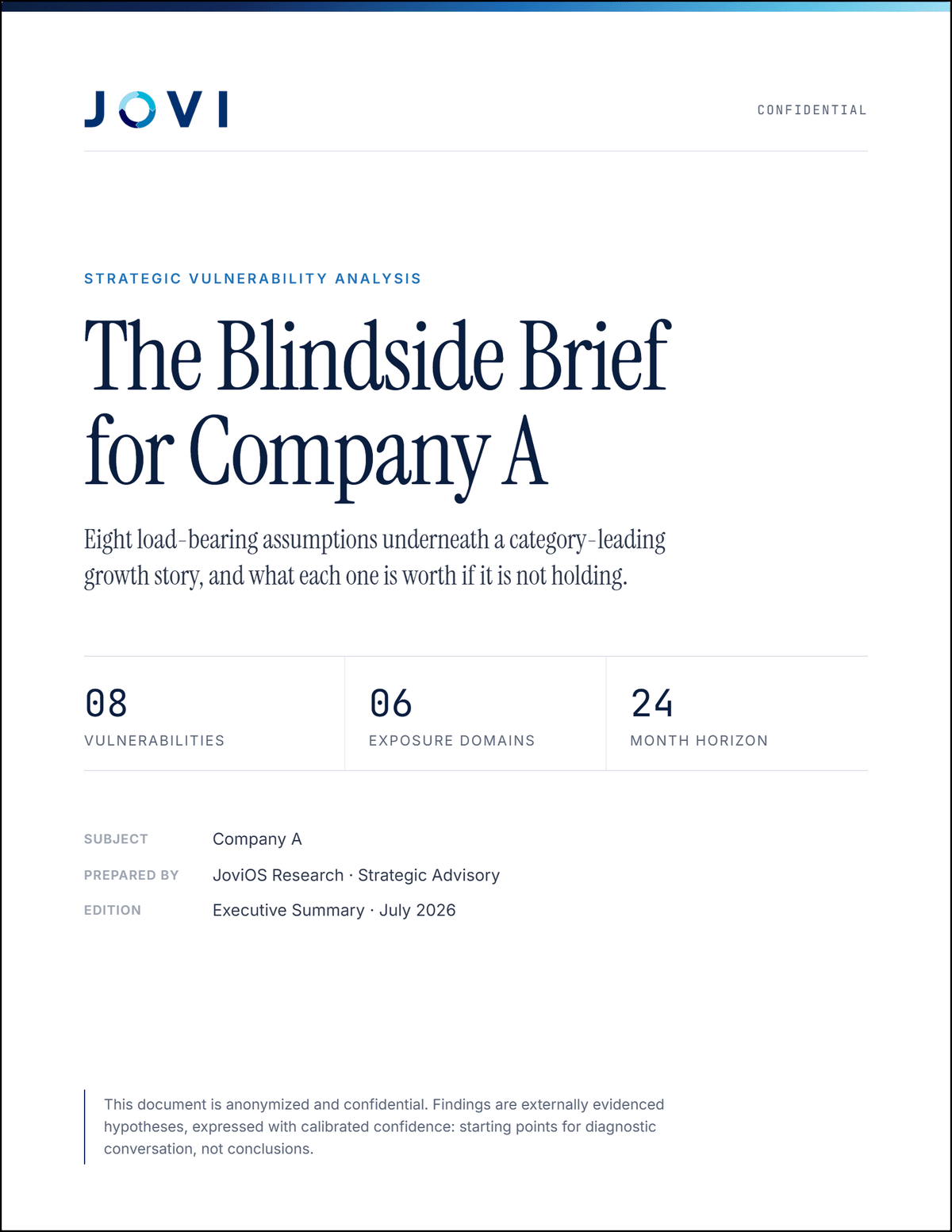
Your plan has already broken in places nobody has flagged yet, leaving your blind side exposed. The Blindside Brief finds those breaks: it shows where the market has moved away from what the plan takes as true, and what that revenue threat is likely to cost.
© 2026 Jovi Corporation. JoviOS is a trademark of Jovi Corporation.
All third-party company, product, and brand names referenced on this site are trademarks of their respective owners and are used for identification and comparison purposes only. Their use does not imply affiliation with, endorsement by, or sponsorship of Jovi Corporation.