
Perspectives
The Board Meeting You Want
The board meeting you want to have is not the one where you explain what went wrong.
It is the one where you walk in with a clear picture of what is working, what is drifting, and exactly what you are doing about each.
The difference between those two meetings is not talent. It is not effort. It is not the quality of your team or the strength of your pipeline.
It is how early you found out.
When a belief your plan depends on breaks, the board conversation is coming either way. The only variable is whether you are the one who surfaced it first or the one explaining it after the quarter confirmed it.
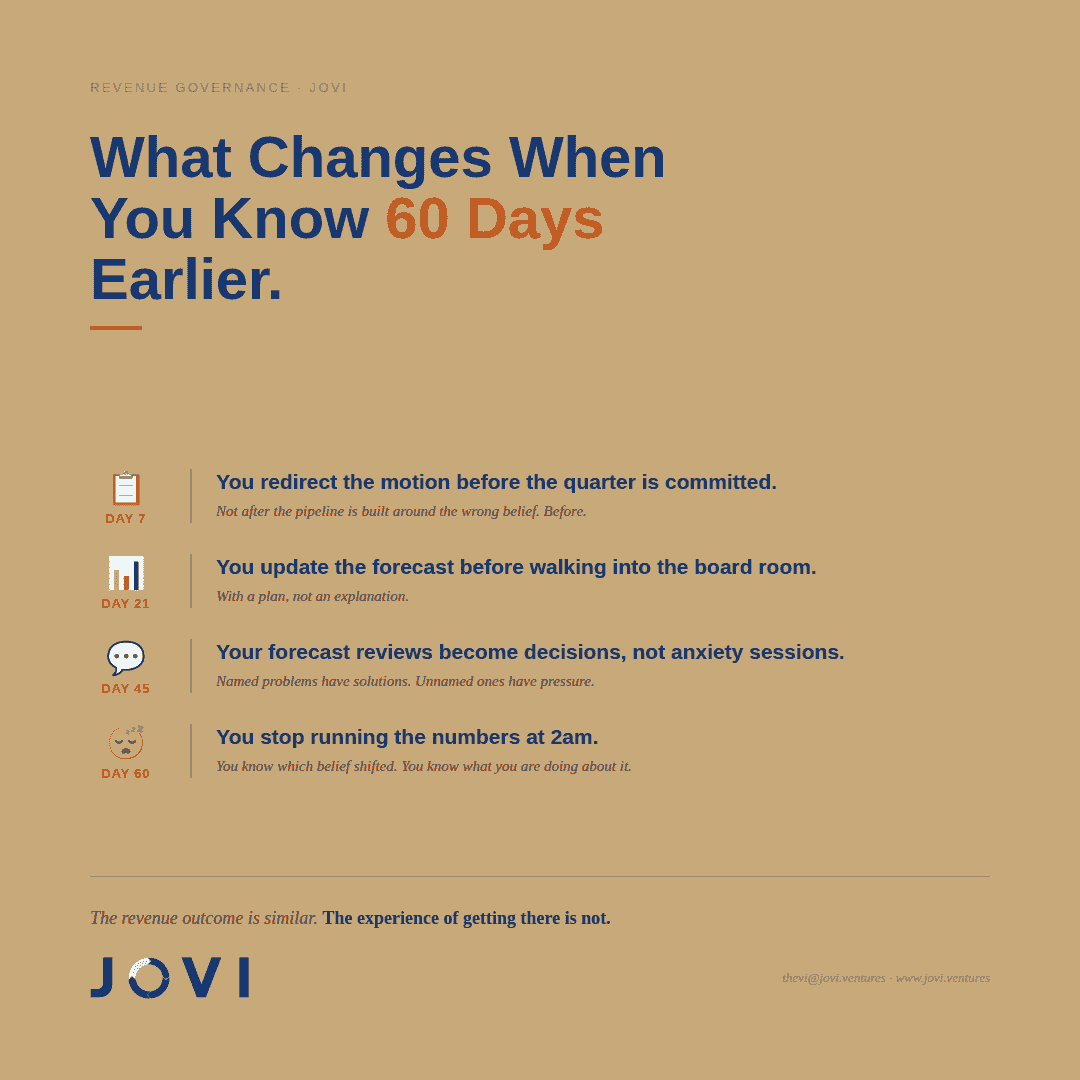
Leaders who surface it first have options. They can redirect the motion, update the forecast, and walk in with command of the situation.
Leaders who find out when the quarter confirms it have the same facts, sixty to ninety days less time, and a very different conversation.
The stress is the same problem. The information is what is different.
What would change about your last difficult board conversation if you had surfaced the break sixty days earlier?Dashboard vs. Beliefs
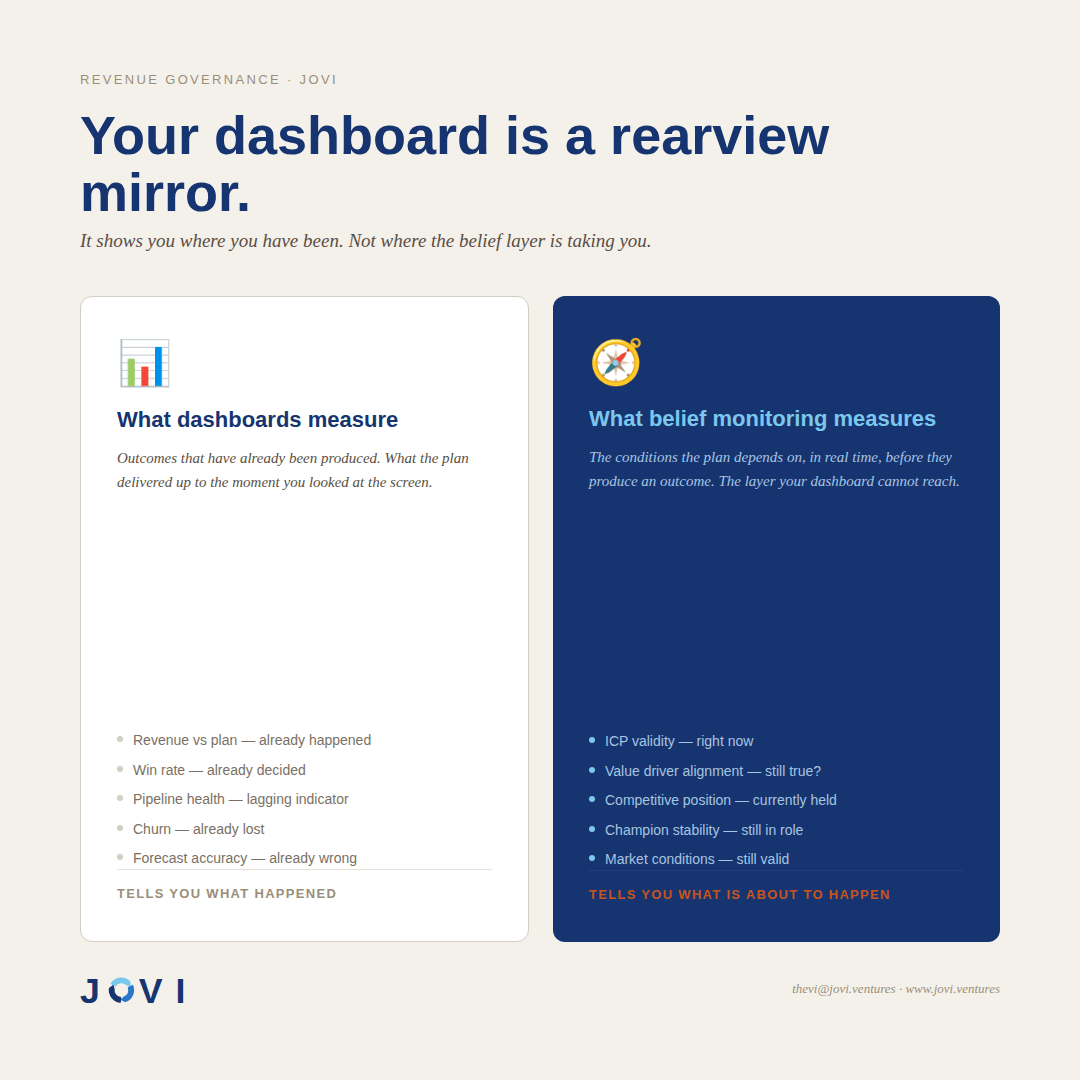
Dashboards only reveal information after it has already happened, while belief monitoring helps you see the problems before they happen.
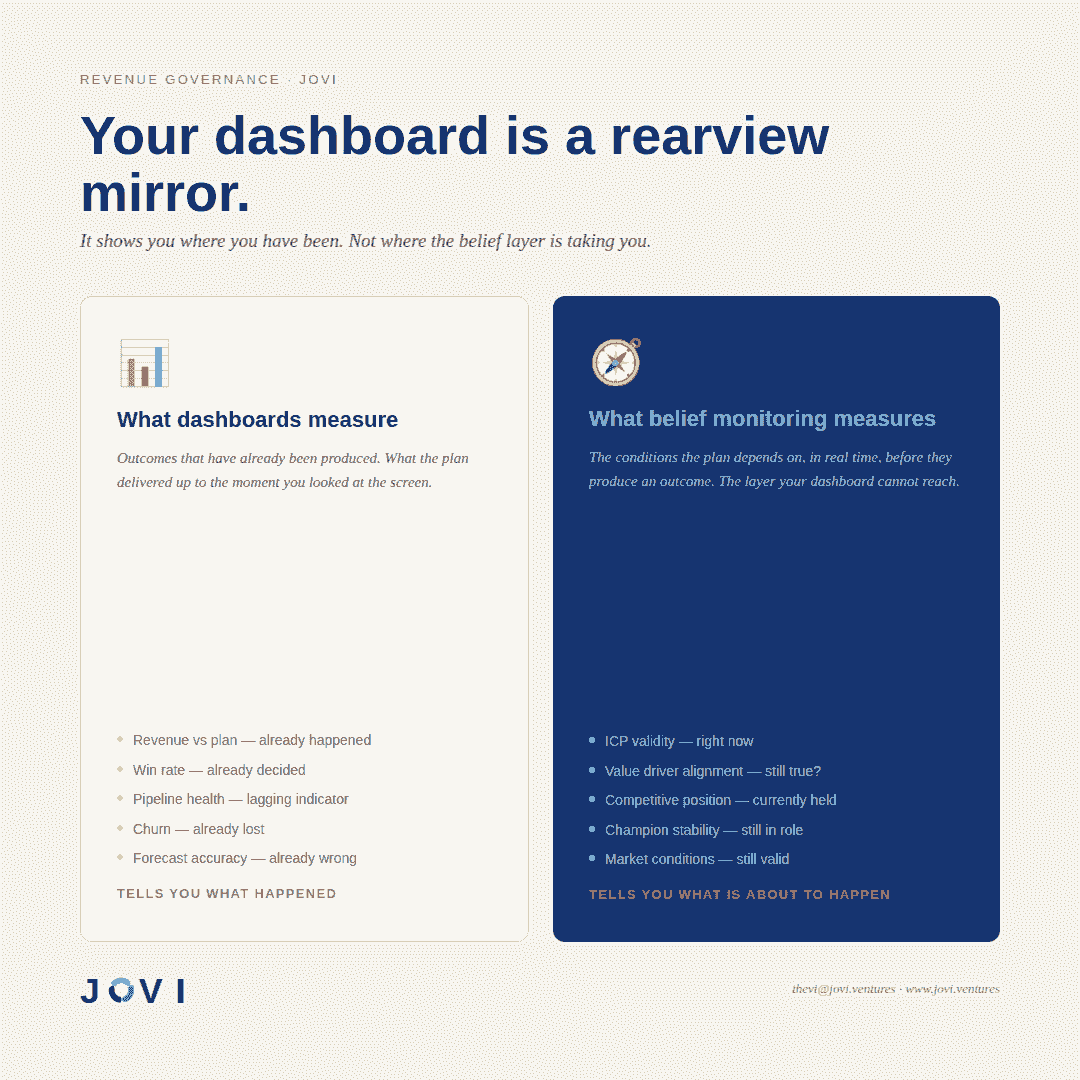
Your Dashboard Is Looking in the Wrong Direction
Your dashboard tells you what already happened.
Belief monitoring tells you what is about to happen.
Most organizations are running one and calling it the other.
The gap between them is where revenue disappears.The Value of 60 Days
Sixty days is not a long time.
Unless you are inside the window where the outcome is still steerable. Then it is everything.
What would you do with sixty days of early warning on a belief that was about to break your forecast?Revenue Management vs Revenue Governance
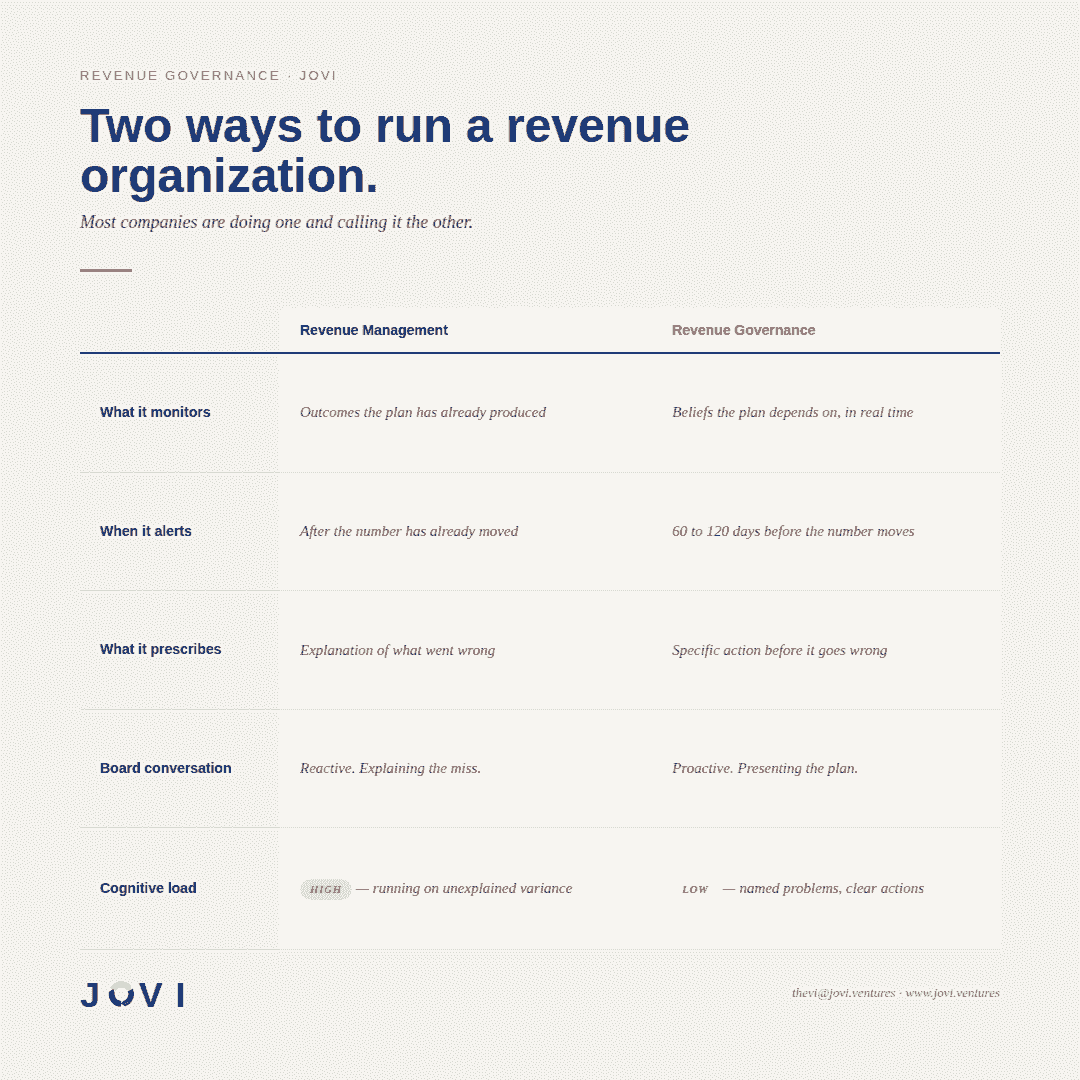
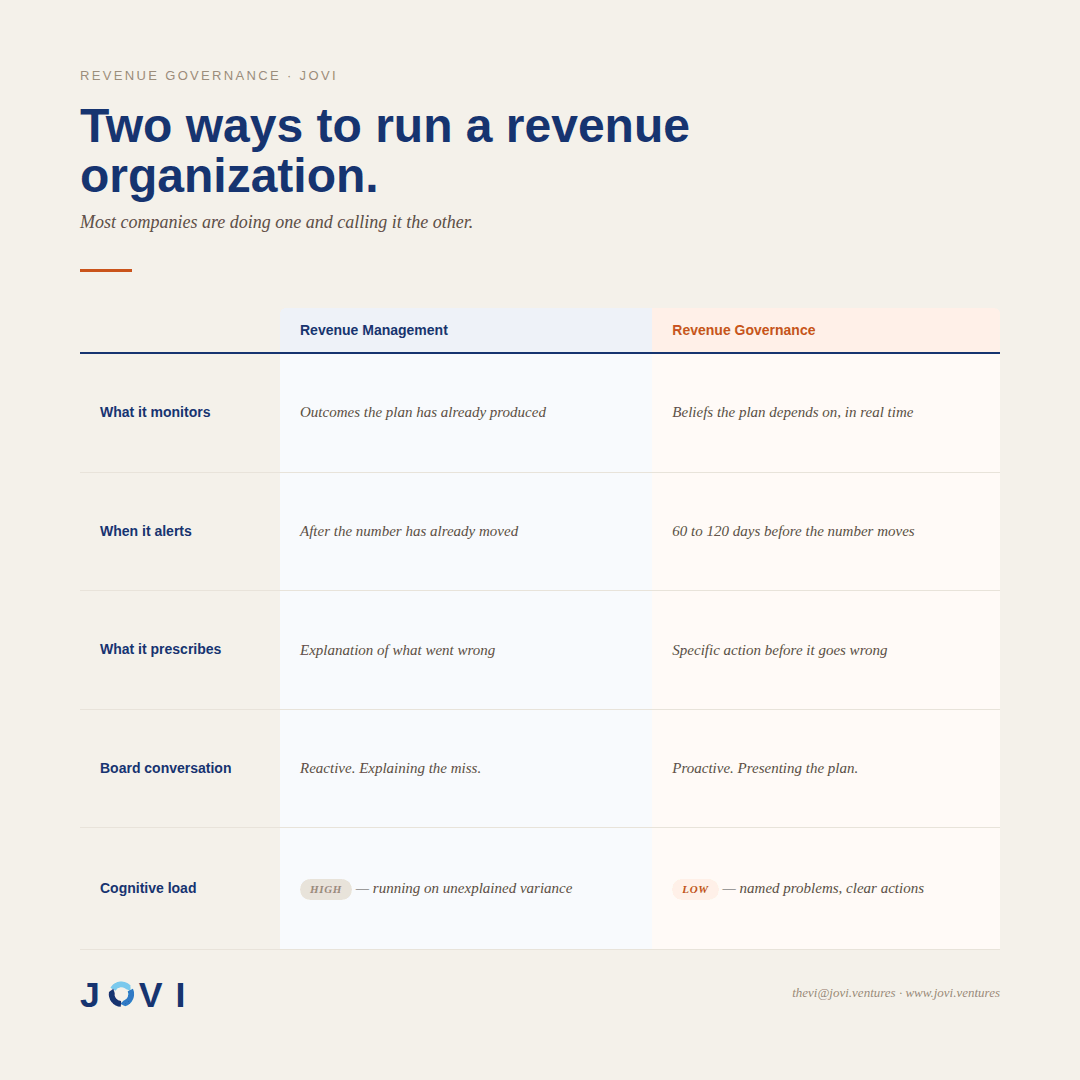
Revenue management tells you what already happened.
Revenue governance tells you what is about to happen, while you still have time to change it.
Most organizations are running one of these and calling it the other.
The difference is not in the tools. Dashboards, CRMs, and forecast reviews are all revenue management systems. They measure outcomes. They are the best systems available for telling you, very precisely, what went wrong after it went wrong.
Revenue governance operates at the layer that produces those outcomes. Not what the plan delivered. What the plan is built on. The beliefs that determine whether the motion will work, whether the number will hold, whether the target is still reachable.
That layer is invisible to every standard reporting system. It produces no alerts when it shifts. It surfaces no signals until the shift has already compounded into a result.
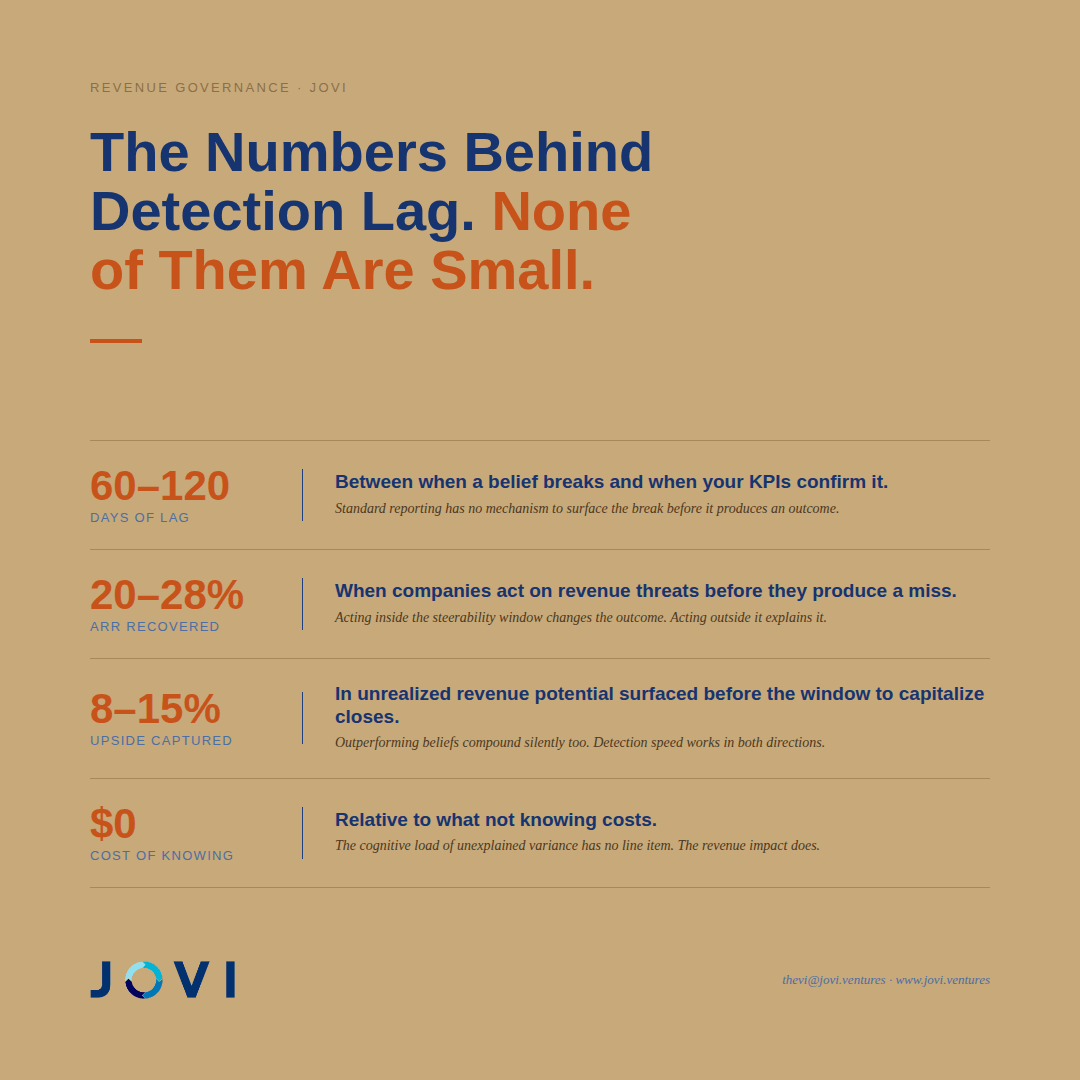
Sixty to one hundred and twenty days of compounding at the belief layer before a single dashboard moves. That is not a gap in your data. It is a structural gap in how revenue is governed.
Most organizations accept it because they do not know it is closable.
It is.The Cognitive Relief Angle
There is a specific kind of calm that comes from knowing exactly which belief broke.
Not because the problem disappears. Because a named problem has a solution.
Revenue leaders who are stressed about their number are almost always stressed about the same underlying thing: they can see that something is wrong but they cannot identify what it is.
The gap is visible. The cause is not. And it is the invisible cause, not the visible gap, that produces the cognitive load.
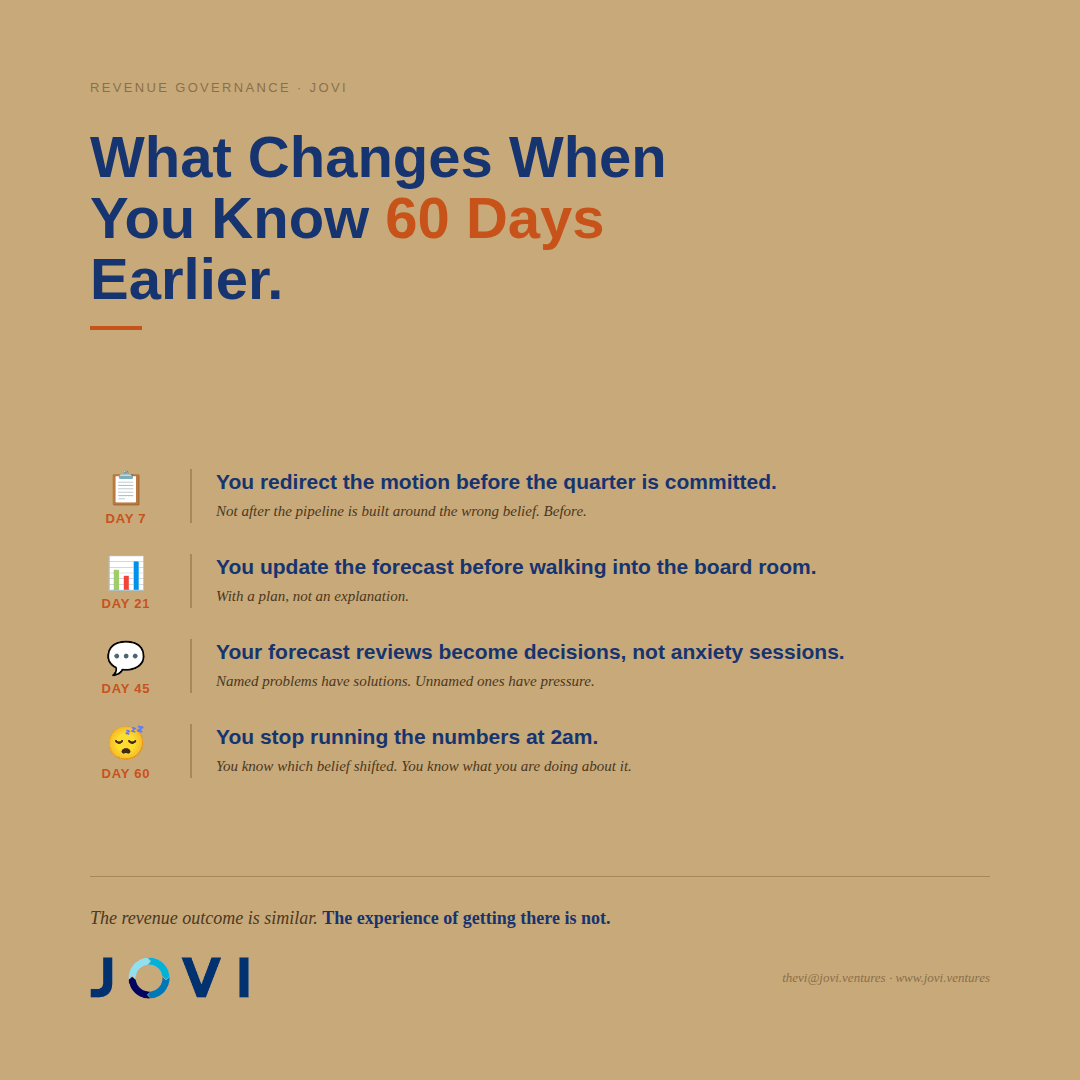
When you know which belief shifted, the entire orientation of the problem changes. You stop trying to explain unexplained variance and start addressing a specific, identified break. The team stops working harder at the wrong thing and starts working at the right one.
The board conversation becomes a briefing instead of a defense. The forecast review becomes a decision meeting instead of an anxiety session.
That clarity is not automatic. It comes from operating with visibility at the belief layer. From knowing, in real time, which assumptions your plan is standing on and which of them have moved.
The opposite of that visibility is not just a revenue problem. It is an exhausting way to run a business.Operating Partner Angle
Operating partners at PE firms spend enormous amounts of time in portfolio company forecast reviews.
Most of those reviews are the same conversation, repeated across different companies, different quarters, different industries.
Revenue is short. Execution is blamed. Activity targets are raised. The team pushes harder. The next quarter arrives. The conversation repeats.
What rarely gets said out loud: the problem is usually not the execution. It is the belief underneath it.
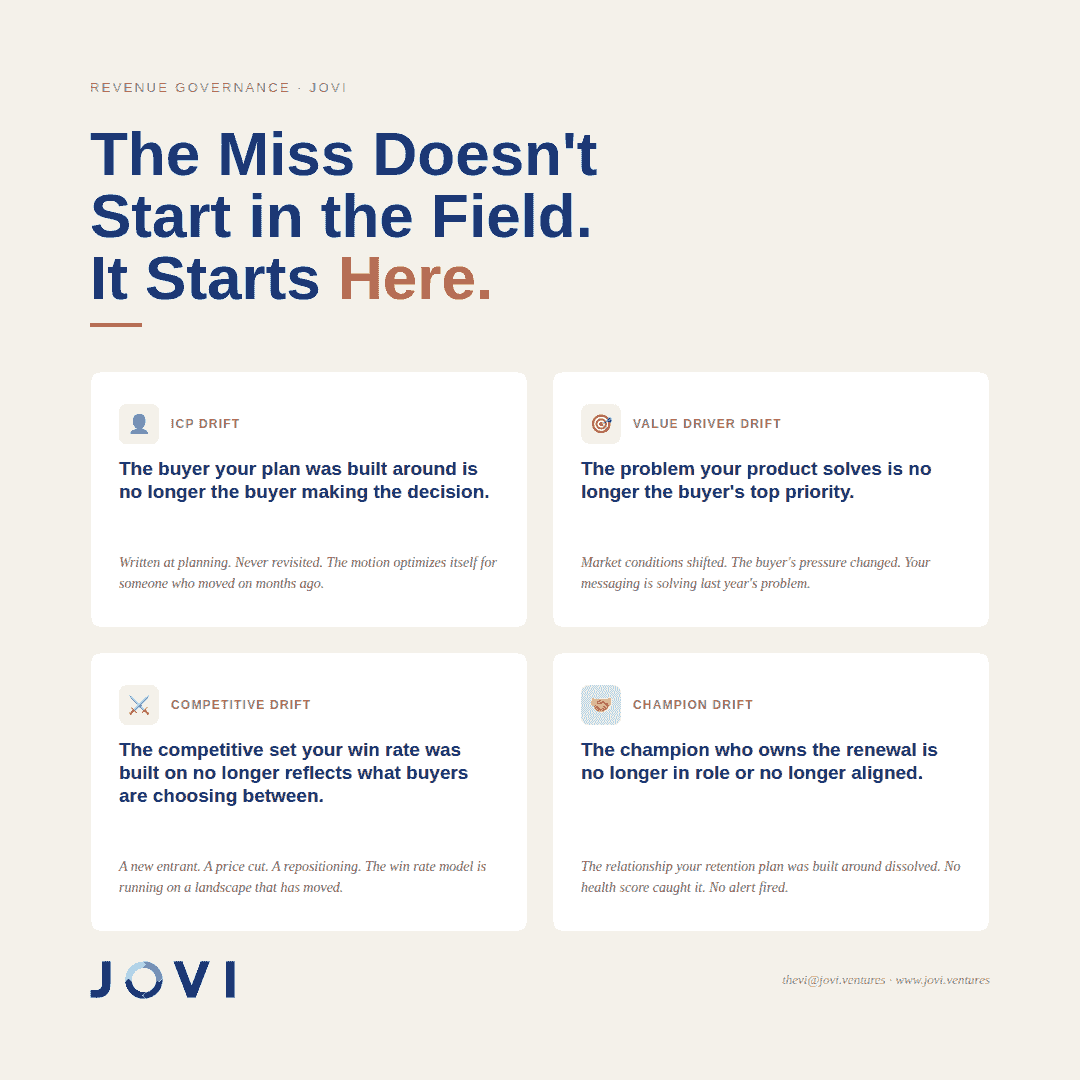
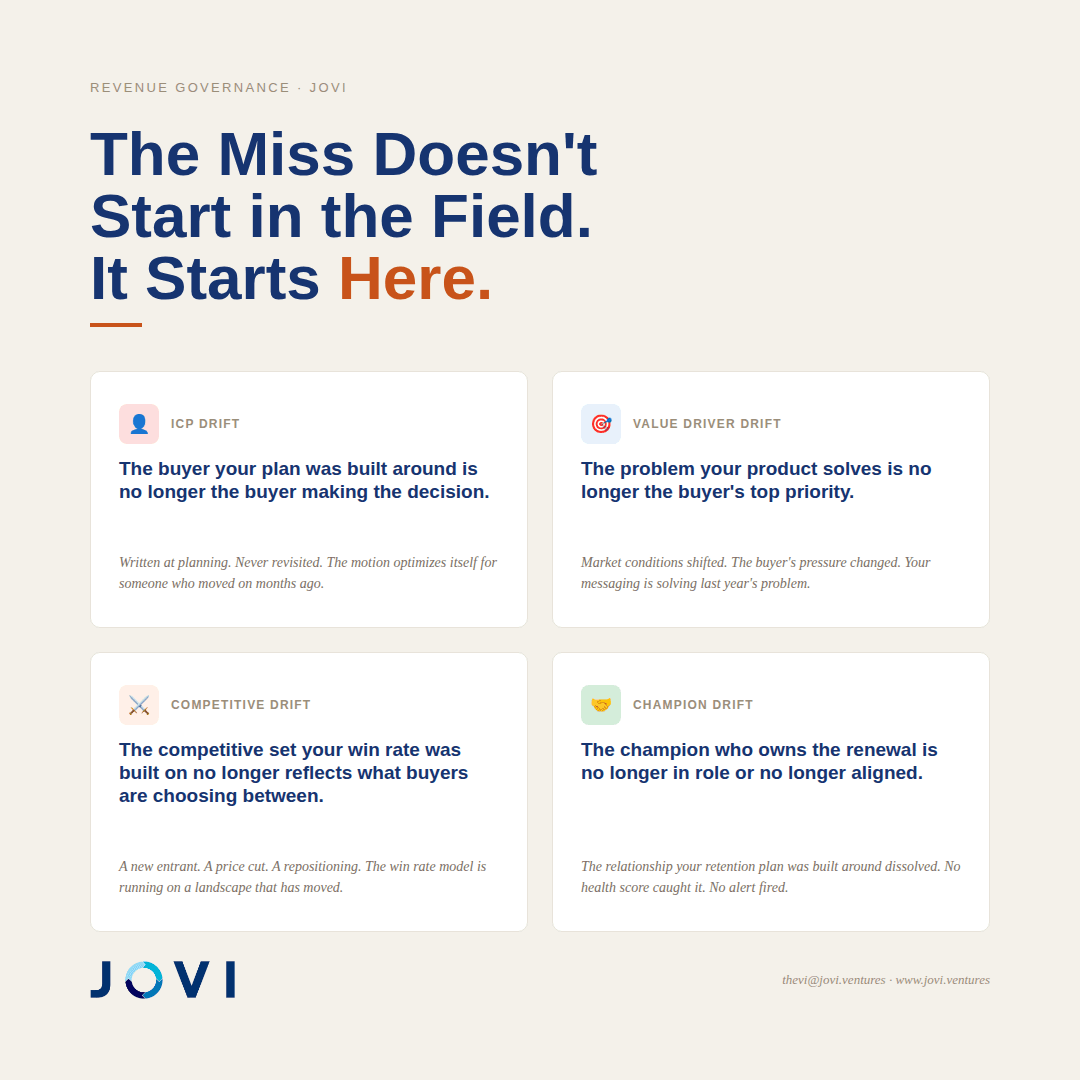
The ICP shifted. The competitive position eroded. The value driver the company built the motion around stopped mapping to the buyer's top priority. The assumption that made this play work in the prior hold period is no longer the assumption the market rewards.
Execution pressure does not fix belief drift. It compounds it. The team runs harder and the results do not follow because the motion is optimized for a version of the market that no longer exists.
The portfolio companies that protect value in a PE hold are not always the ones with the best execution. They are the ones who know, in real time, when the ground beneath the plan has shifted and still have time to act.
Detection speed is a financial variable. In a three to five year hold, the difference between catching a belief break in week two and catching it in month four is material.
When was the last time you validated the beliefs underneath a portfolio company's plan rather than the results on top of it?The Number Before the Number
There is a number your current reporting system cannot give you.
Not the revenue number. Not the pipeline number. Not the win rate or the coverage ratio or the days to close.
The number that tells you whether those numbers are still accurate.
Every metric in your forecast is downstream of a belief. The win rate is downstream of a belief about competitive position. The coverage ratio is downstream of a belief about cycle length. The NRR assumption is downstream of a belief about champion stability.
When those beliefs are current, the downstream metrics are reliable. When they drift, the metrics keep moving in the direction the original belief pointed, while reality moves in a different direction.
That gap compounds for sixty to one hundred and twenty days before a single dashboard reflects it.
The number before the number is the belief health score. How valid are the assumptions your current metrics are built on? Which ones have shifted and by how much?
Most organizations never see that number. They wait for the downstream metrics to confirm what the belief layer already knew.
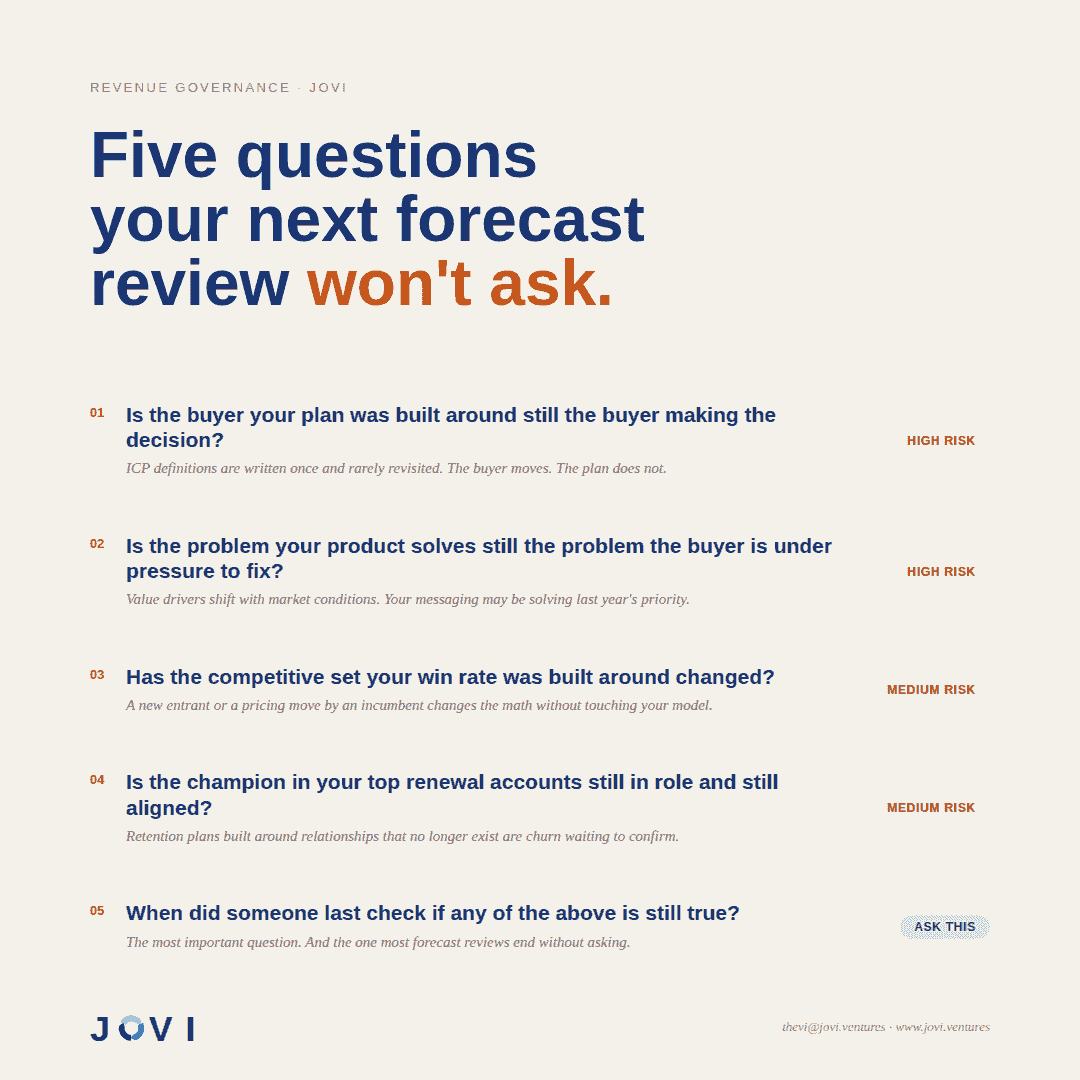
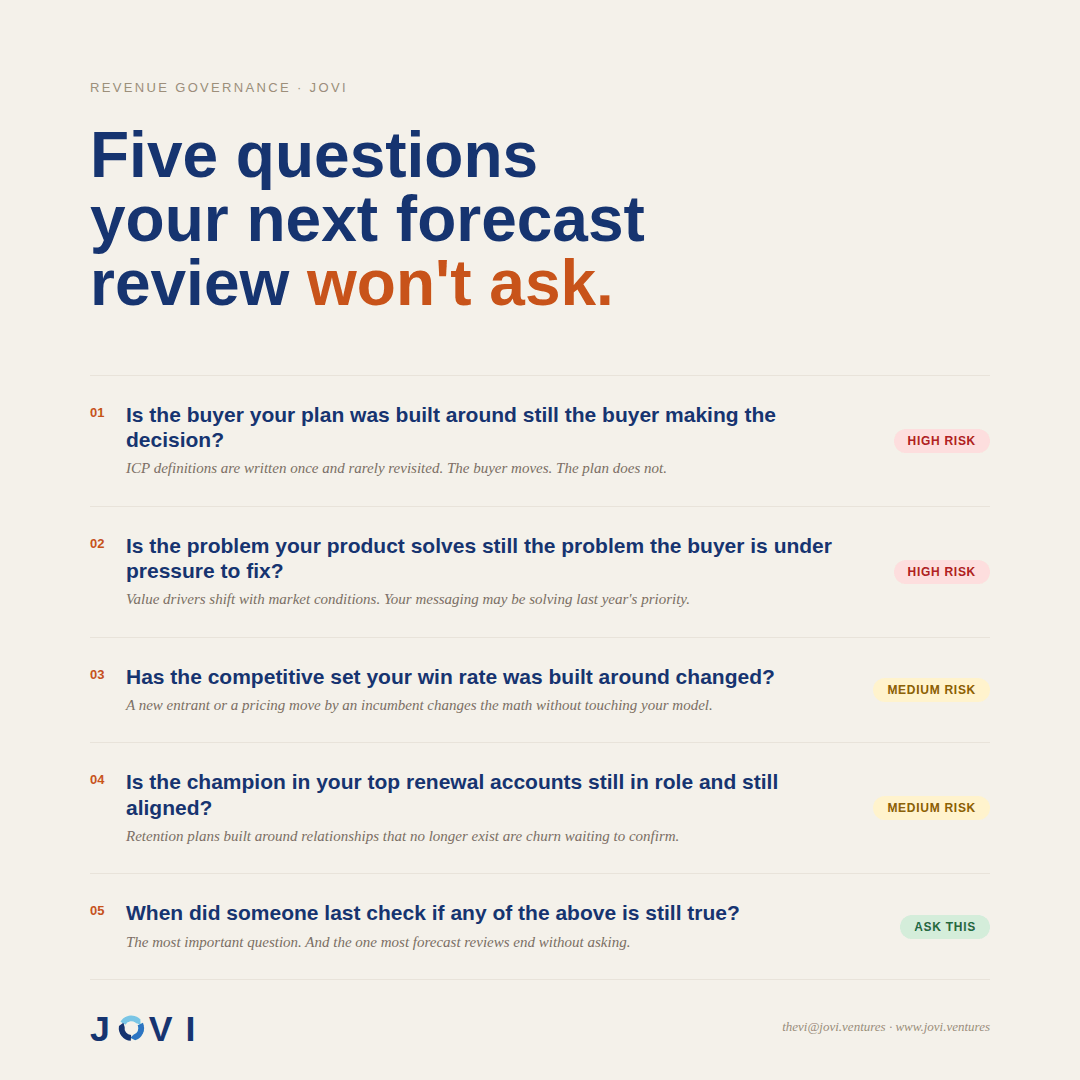
By then, the window to act has closed.Five Questions Your Next Forecast Review Won't Ask
What Changes When You Know 60 Days Earlier
The Miss Doesn't Start in the Field. It Starts Here.
Your Plan Has Assumptions No One Wrote Down
Recently, I've been pondering how people discuss verifying assumptions during planning, such as pricing, demand, and hiring. These are typically documented because everyone recognizes them as assumptions. However, I question whether these are truly the assumptions that cause the most complications. Often, the bigger issues stem from assumptions people aren't even aware they are making.
Picture a company preparing for a continuously growing market. A major customer segment has been steadily purchasing for years. Everyone presumes this trend will stay the same, but no one records the reasoning behind it. It simply feels natural. No one clearly says, "We assume this customer group will keep buying at the same rate." Since it wasn't explicitly mentioned, it wasn't discussed.
Months later, these customers reduce their purchases, making the original plan ineffective. People sift through data to identify what changed, but the initial assumption was never documented. It remained an unspoken understanding shared by all. Consequently, no one verified it, discussed potential impacts if it changed, or paid particular attention to it, since it wasn't formally acknowledged as an assumption. The lack of an explicit trigger meant the belief was never openly addressed.
This situation probably happens more frequently than you may think (I see it all the time). People often focus on examining the assumptions they've documented and questioning their validity. While this is important, the greater blind spot isn't necessarily the assumptions that proved false. Sometimes, it's the assumptions that the plan never even considered in the first place.
All plans include written assumptions, but many implicit ones are assumed to be obvious. However, they might be just as important since no one is paying attention to them.
Before finalizing any plan, it’s important not only to identify risky assumptions but also to ask, "What are we secretly assuming?" Someone must reveal these unstated assumptions before the plan is finalized. This ensures there's a tangible reference point to revisit later, instead of discovering halfway through the year that everyone depended on an unspoken assumption that was never documented.No One Rechecks the Assumptions Behind the Longest Commitments
I've observed that as companies plan further into the future, fewer people challenge the assumptions behind those plans.
Meanwhile, their commitments keep growing.
In the first year, everything is closely examined, e.g., prices, demand, hiring, costs, since it's imminent.
But by year three or four, the targets and figures are still there, yet few revisit whether their original assumptions are still valid.
They often just stay because they were set long ago.
The farther out the commitment, the less attention the foundational assumptions seem to get.
For instance, a company might decide to invest heavily now, expecting demand to stay strong in three years.
Initially, everyone agrees, and the investment moves forward.
But two years later, market conditions or customer behavior might change.
The assumption could be invalid, yet the funds are already committed, making it harder to pivot.
By then, the window to change course has closed.
This isn't about poor predictions; change is normal. I believe the answer isn't perfect forecasting (which is impossible) but rather periodic reviews of long-term assumptions before it's too late.
When assumptions sit untouched for too long, it's easy to forget why they were made.
The biggest, most long-term commitments often rely on assumptions that haven't been questioned in a long time.
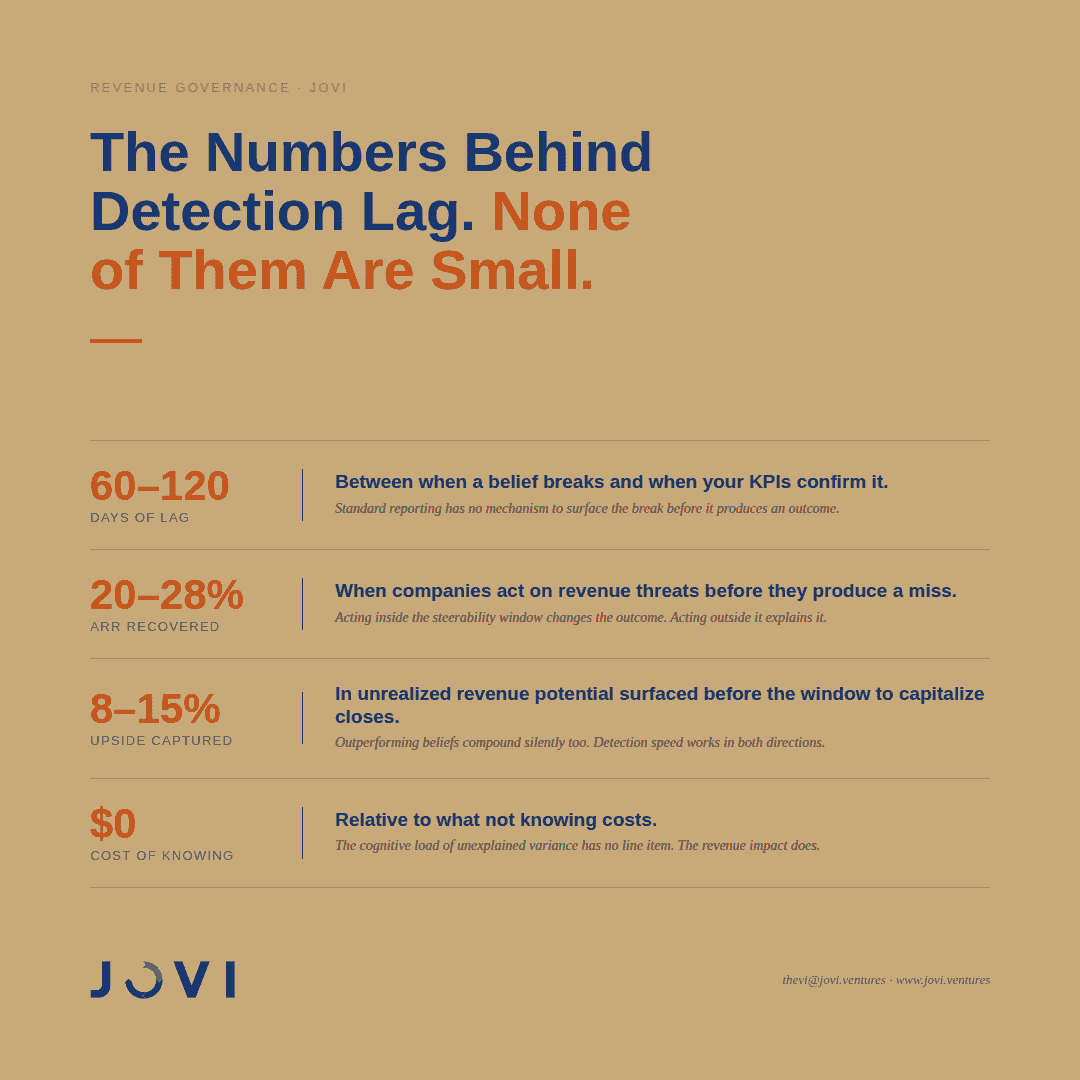
Regularly rechecking these long-term assumptions allows companies to adapt while there's still time to act.The Numbers Behind Detection Lag. None of Them Are Small.
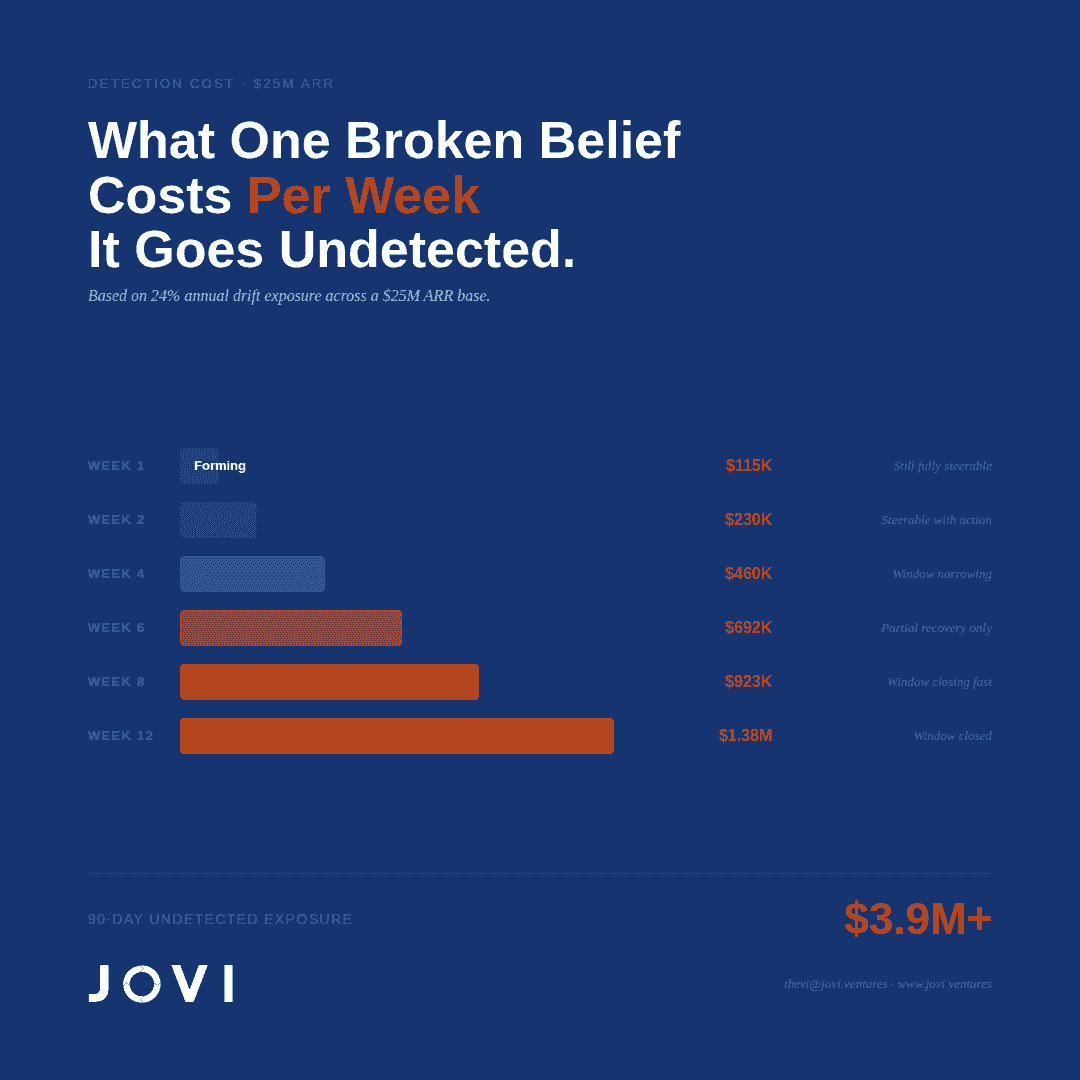
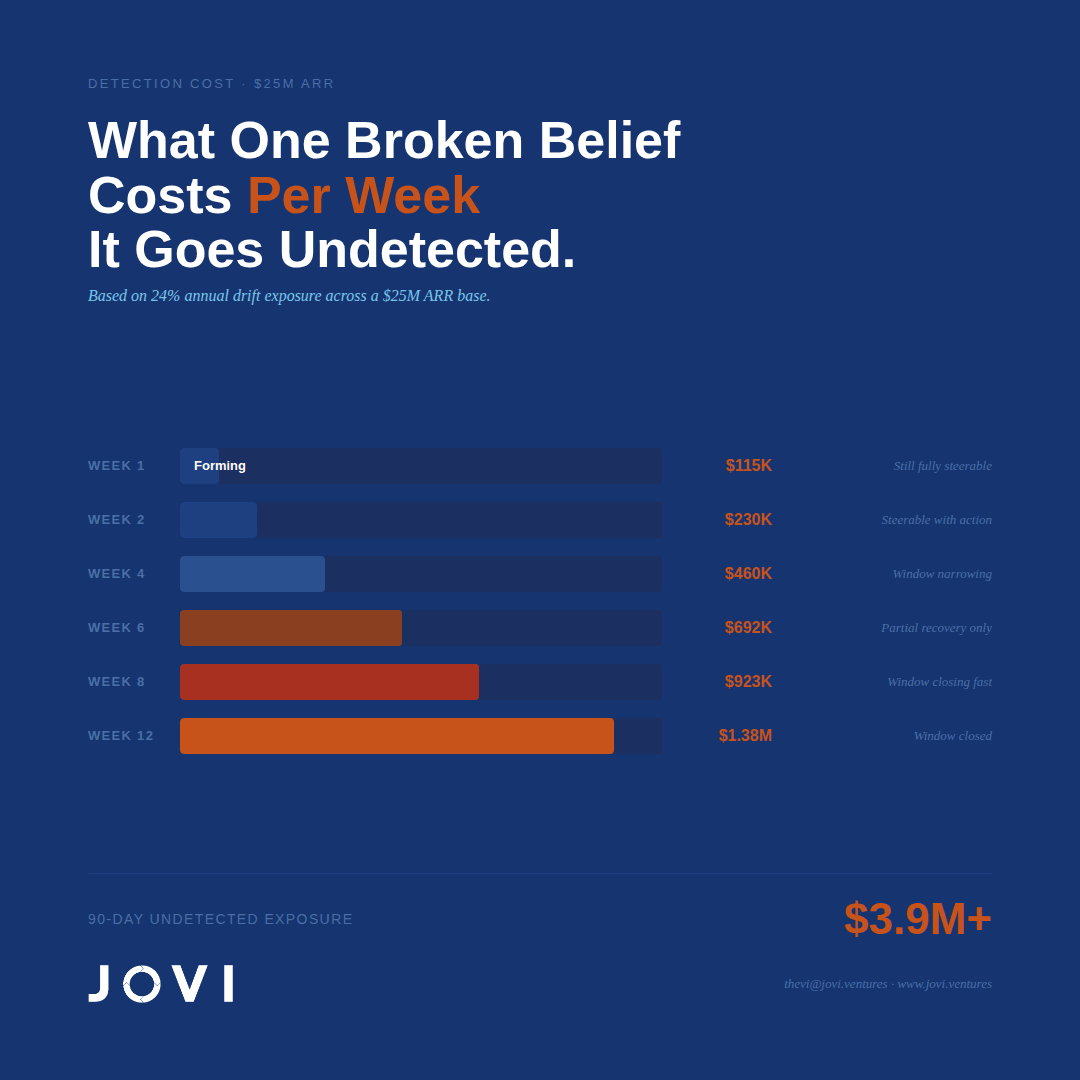
What One Broken Belief Costs Per Week.
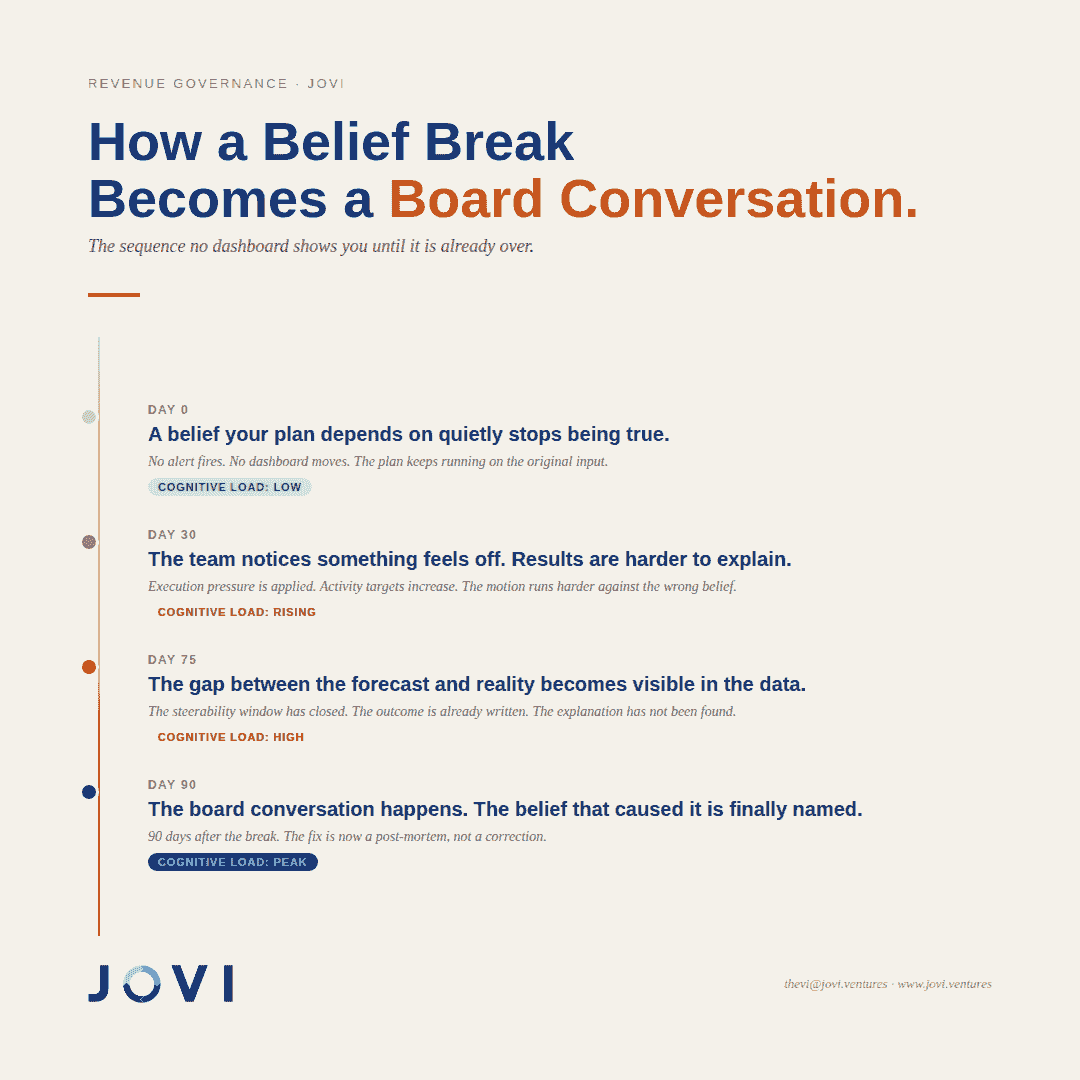
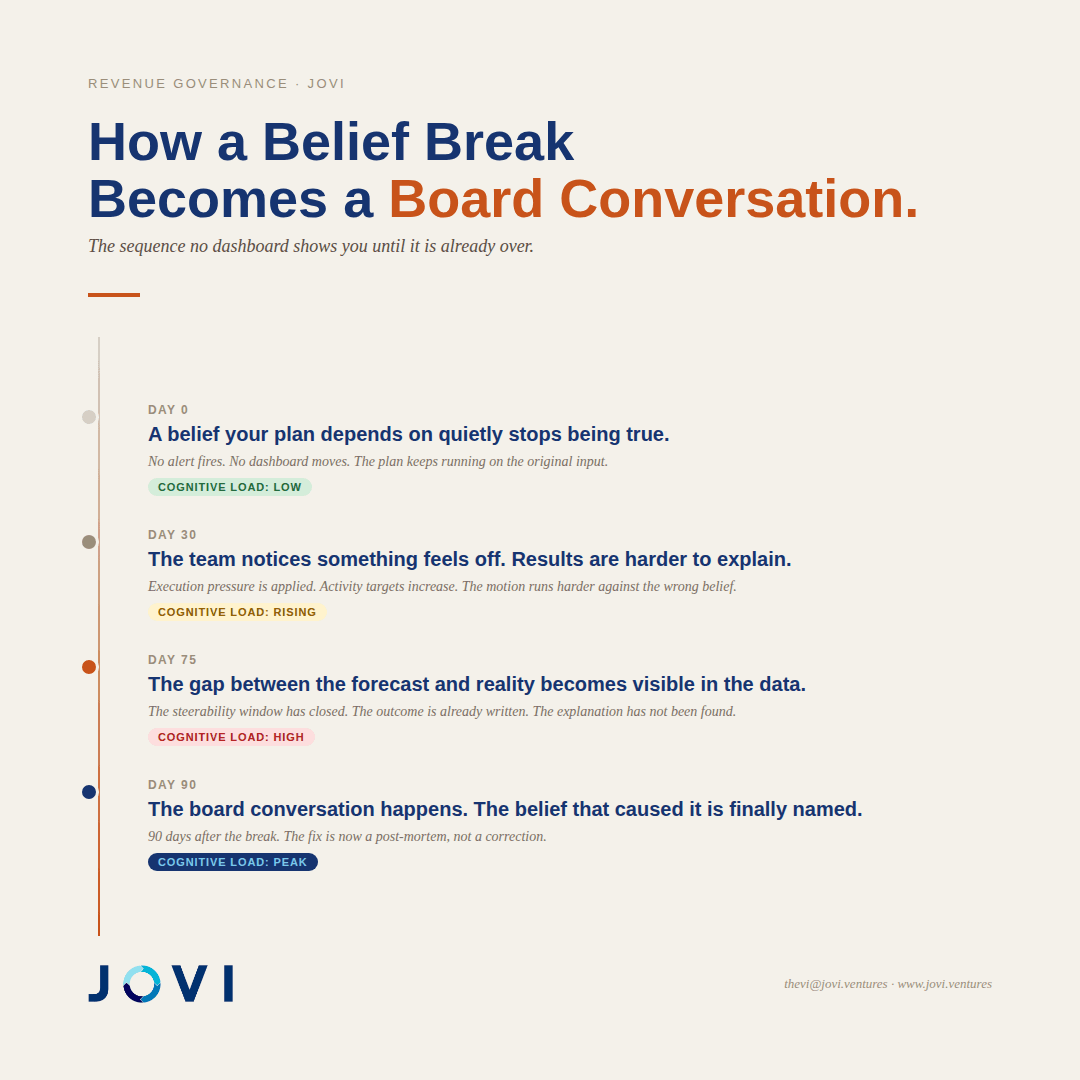
How a Belief Break Becomes a Board Conversation.
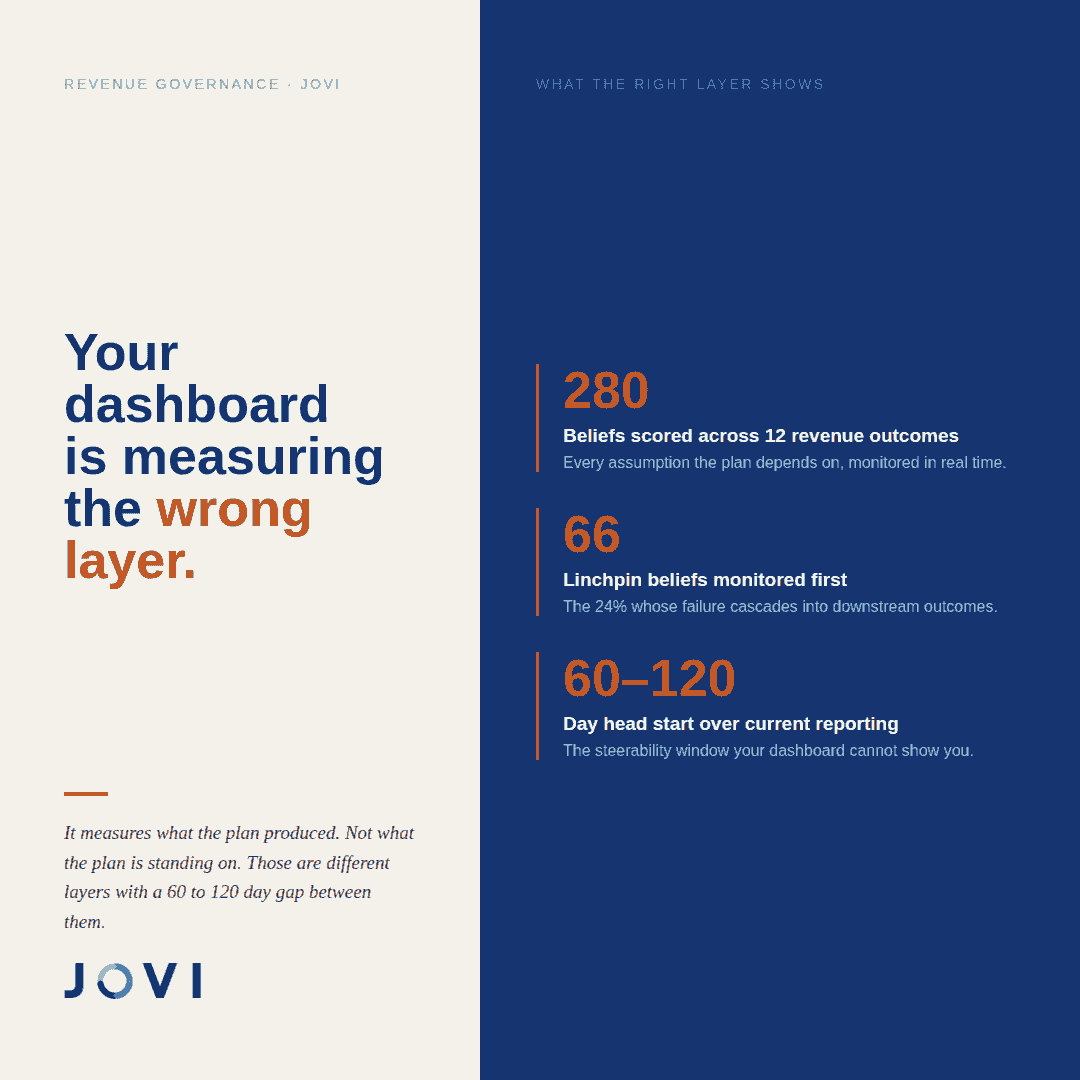
Your Dashboard Is Measuring the Wrong Layer.

© 2026 Jovi Corporation. JoviOS is a trademark of Jovi Corporation.
All third-party company, product, and brand names referenced on this site are trademarks of their respective owners and are used for identification and comparison purposes only. Their use does not imply affiliation with, endorsement by, or sponsorship of Jovi Corporation.